

Publishing academic work is a fundamental part of every scholar’s career. This might be your first attempt, or maybe you have been publishing for many years.
No matter your level of experience, preparing a manuscript to submit to a journal can be both daunting and exciting.
This article introduces the factors that authors should consider when deciding which journal to submit their work. By being strategic, focused, and detail-oriented, you can position your paper in line with the target journal.
It also provides a brief overview of some of the general requirements for journal submission. Then, it walks you through the process of submitting a manuscript to a specific journal.
Targeting your work
You might already know which journal(s) you want to publish your work in. If you’re not sure, no need to worry. Either way, it’s important to take some time to figure out which journal is the best fit.
To increase your chances of publication, evaluating your research and identifying the right journal are essential. Consider: What kind of work does the journal publish? What kind of article are you writing (a literature review, a research paper, etc.)? What is the relevance and contribution of your work to the discipline broadly, and to the journal in particular?
There is a higher chance of publication if your work fits well with their scope and readership. So, target a certain journal and customize your paper accordingly.
Also, being realistic and honest with yourself about your work is the ideal approach. Submitting a manuscript before it is ready and/or sending it to an inappropriate journal are two common mistakes.
There are various factors to consider when choosing a journal:
- Aims and scope;
- Impact factor and reputation;
- Timeline of peer review and publication;
- Rejection rate;
- Open access or closed access;
- Article processing charge.
In some cases, all of the factors are more or less equally considered. In others, one factor might make the difference. You might want to get work into the journal with the highest impact factor and the best reputation in your field. For others, it may be based on the aims and scope of the journal.
Making choices for submission
Whatever your decision, customizing your work to your target journal is the best path to successful publication.
In many ways, it is best to know which journal you are submitting to before you start writing. Of course, though, this is not always possible.
Many scholars may have already written a paper before they knew their target journal. If you are in this situation, you can approach this process in a couple of different ways.
For example, you could figure out which journal(s) your work fits best with “as is.” If your work is in good shape and already fits particularly well with a publication, you may save time and energy. But, this may limit where you can send your work, and whether or not it is accepted.
On the other hand, if there is a certain journal that you really want to publish in and you are willing to put in the work, you can “reverse engineer” the process. That is, you can revise the manuscript based on the specifications of that journal. While this can involve more time in revisions, it may increase the chances of publication.
General guidelines
Most journals consider original manuscripts that fulfill all the required elements. The submitted work should not be published or under consideration elsewhere. Papers previously posted as preprints, as long as they have not undergone peer review, are often also submitted.
While you can expect to find some standard practices, each journal has its own set of requirements. Journals have extensive instructions for authors available on their website, so you can follow the guidelines to the letter. Any missing or incorrect information may result in a paper being rejected outright, before peer review.
This is why it is so important to have a good point person as the corresponding author(s). They are entrusted with the responsibility of taking you and your colleagues through the publication process. This includes ensuring that the paper has been finalized and approved by all authors. And you may be asked to submit a brief cover letter to provide further context.
Manuscripts reporting studies involving human participants must include a statement of informed consent. In addition, there are ethical requirements for conducting studies with human and/or animal subjects. Authors must also declare all conflicts of interest.
It’s also important to check whether or not a specific journal charges an article processing fee. This may include minor English editing, and authors may be able to purchase an extensive editing package if desired. Payment should be arranged at the time of submission.
Before you begin
After completing your manuscript, but before starting your submission, double-check the journal’s checklist to ensure you include all required elements.
Authors are typically not required to follow a certain section order. However, an introduction, materials and methods, data results and analysis, and a conclusion are essential components.
Check to see if authors are required to: use a particular reference and formatting style, if there is a template available to use, and what kinds of supplementary documentation are needed.
Authors are typically encouraged to include a short professional biography that includes institutional affiliation. You can also suggest three particular reviewers with expertise in your field (though the editor is under no obligation to select from this list).
Example of step-by-step submission
Before you begin, ensure that the paper has been finalized and approved by all authors. Authors can download the specific Word or LaTeX template for Cancers to use. Gather any necessary documentation, such as graphs, figures, data, etc., that will be included with the Supplementary Materials.
What are the formatting requirements? What reference style is preferred? And what are the required elements of each manuscript?
While this is not the case for all journals, Cancers accepts free format submission. This means that authors may use any citation style, as long as it is consistent.
Authors are encouraged to include a short professional biography that includes their institutional affiliation.
Manuscripts reporting studies involving human participants must include a statement of informed consent for participation in research. There are also specific ethical requirements for conducting studies with human and animal subjects. Authors must also declare all conflicts of interest.
You can also suggest three particular reviewers with expertise in your field (though the editor is under no obligation to select from this list).
Step-by-step submission
Here is a guide to navigating the easy-to-follow process of submitting a manuscript through MDPI’s submission system.
You can save your work as you go. Just click the “Save” or “Save & Continue” button on the bottom right of your screen at any time.
First, sign in to your Susy account. Once you have done that, select “Dashboard” on the top left column, and then “Submit Manuscript” on the right.

The system will navigate you to a drop-down menu for journal selection.
Once selected, core information about the journal will be shown on your screen. This includes its impact factor, average number of days to receive a first decision, and manuscript templates.
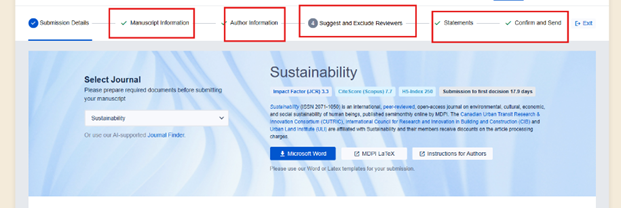
Now that you are on the page for the specific journal, scroll down to upload your files: manuscript, cover letter, and any supplementary materials.
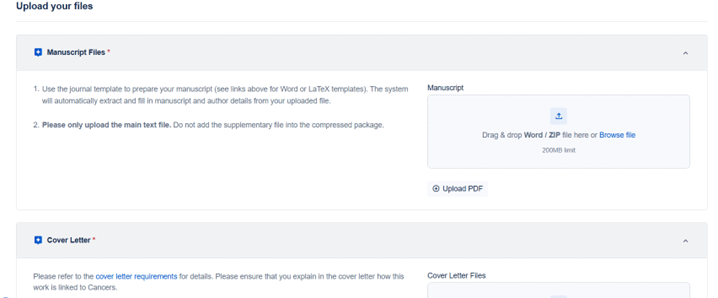
As you can see below, there are different sections for this additional documentation. This includes graphs, figures, and any other media.
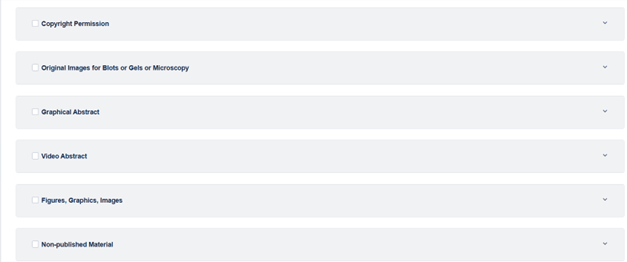
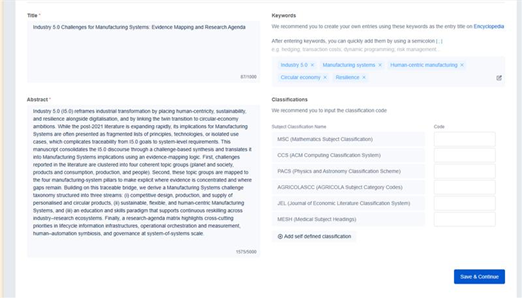
Once you have completed this information, click “Save & Continue” at the bottom right of your screen.
Next, complete the manuscript information section (abstract, title, keywords).
Then, complete the author information (affiliation, email, country, etc.).
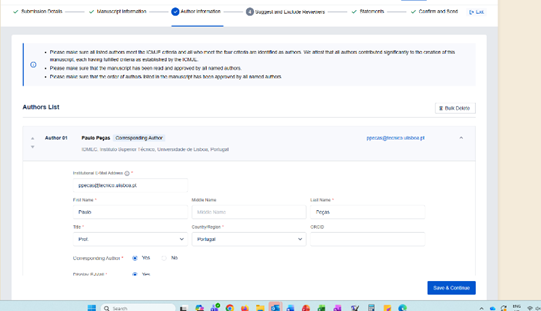
At this stage, authors can suggest potential reviewers for their paper.
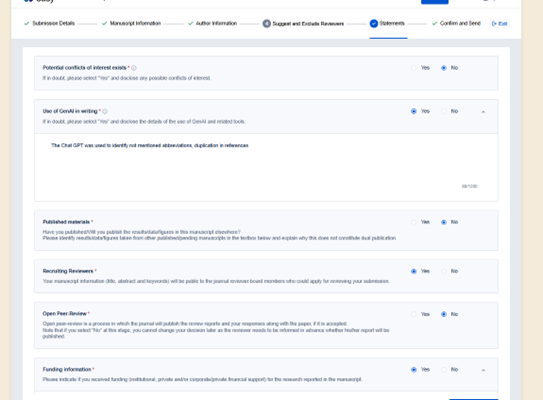
And, finally, complete the various disclosure statements.
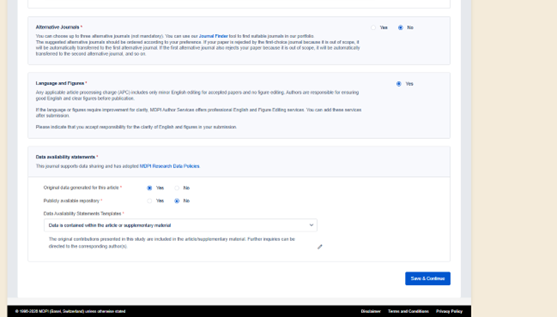
Click “Save & Continue.” You have now filled out all required elements and successfully submitted your manuscript.
Waiting after submission
Now you wait until the first decision from the journal. If you are successful, the next step is peer review, and then on to production from there. Having seen how to navigate manuscript submission, hopefully, it will be an easier process for you.
If you are uncertain at any point, it’s always worth it to ask someone who has successfully published for any advice or tips. And, don’t be afraid to contact the journal directly if you have any questions or concerns. Good luck!
Last updated on: July 25, 2026