

1. Introduction
The invitation to share my insights and experiences as a peer reviewer on the SciProfiles blog challenged me.
In 2020, I was invited to review a manuscript submitted to an international academic journal. I received the invitation enthusiastically and tried to write a good review report In 2022, I was invited to be a Reviewer Board Member of the MDPI journal Antibiotics, and a few weeks later, I was asked to participate in a webinar during peer reviewer week.
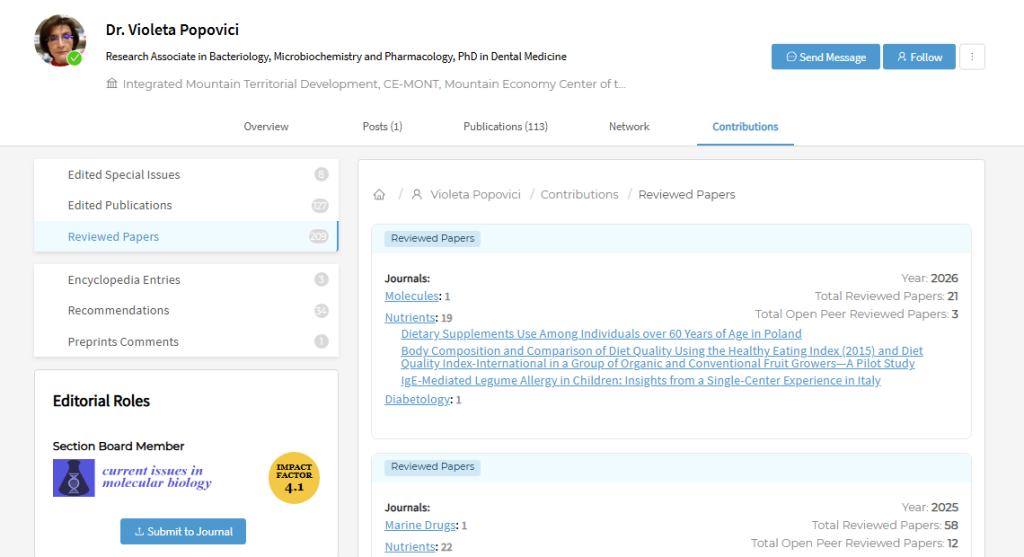
Since then, I have decided to do my best as a reviewer, and my activity has significantly increased in the last 3 years. As a reward for my efforts, I received the Antibiotics Outstanding Reviewer Award in 2023 and 2024.
My awareness has continuously increased with time, and my aim of providing high-quality review reports persists. I have reviewed over 135 papers in MDPI journals; my Web of Science Researcher profile records 237 peer-reviews of 161 manuscripts. They have an average of 392 words per review report, which is higher than the academic average (361).
My experience continues to increase—I recently became a Section Board Member of another MDPI journal (Current Issues in Molecular Biology)—and, proportionally, I aim to improve the quality of my afferent activities. The peer reviewer skills I have developed are very helpful when I am invited to make an editorial decision.
2. Background
A recent study analyzed the quality of 313 reviewer reports (within an average length of between 406.57 and 631.31 words) in a requested time range of 14-203 days. The results showed that the difference in quality between the shorter and longer reviews was not considerable [1]. The study demonstrates that efficient and high-quality peer review can be achieved without extensive time or lengthy reports. Reviewers’ age is also a significant predictor of review quality [2].
The increasing rate of manuscript submissions in various academic journals requires numerous reviewers to be available for the peer-review process. The most well-known academic journal platforms have experimented with implementing artificial intelligence (AI) in the peer-review process to efficiently address these challenges [3]. Despite AI’s minimal time requirements to produce a review report (2.5 ± 1.8 min) compared to humans (7.5 ± 2.8 weeks), human re-viewers achieved higher scores in Clarity of Feedback, Depth of Analysis, Literature Engagement, and Overall Quality.
How, then, does a reviewer provide suitable review reports and help authors improve their manuscripts? Each academic journal has instructions for reviewers and describes the essential aspects point by point, but the reviewers’ understanding, motivation, and attitudes are essential to the peer-reviewing process.
3. Responsibility
Understanding the reviewer’s key role as a link between editors, authors, and readers underlines a key aspect of the willingness to provide a high-quality review report. This involves the following objectives.
3.1. Ensuring the Quality Control of Manuscripts
For editors:
Peer reviewers assess a manuscript’s quality, validity, and significance. This helps editors make informed decisions about whether to accept, reject, or request revisions for a submission.
For authors:
Reviewers offer constructive feedback, highlighting strengths and weaknesses in the research, methodology, and writing. This helps authors improve their work before publication, increasing its impact and credibility.
For readers:
Peer reviewers act as a filter, ensuring that published research meets rigorous quality standards. This gives readers confidence in the information’s reliability and trustworthiness.
3.2. Maintaining Academic Integrity
For editors:
Reviewers help identify potential issues, such as plagiarism, data fabrication, or ethical concerns, safeguarding the publication’s integrity.
For authors:
Reviewers encourage authors to adhere to high ethical standards in their research and reporting.
For readers:
Peer reviewers ensure that published research is original, properly conducted, and free from significant flaws.
3.3. Promoting Scholarly Communication
For editors:
Reviewers often provide context and perspective on a study’s contribution to the field. These aspects help editors decide whether the manuscript fits the journal’s scope and direction.
For authors:
Peer review can be a valuable learning experience, exposing authors to different viewpoints and approaches within their field.
For readers:
Peer review ensures that published research is relevant and timely and contributes to the ongoing dialogue within a specific study area.
4. Empathy
Many reviewers are concomitantly in the positions mentioned above: readers, authors, and editors. When they receive an invitation to review a manuscript, they should be aware of the trust that is put in them, the immense impact of their report on the authors, and their duty to provide valuable, well-written, and helpful articles to potential readers.
They should also realize how lucky they are to be invited to contribute, develop their abilities, and gain experience and credibility in the academic world.
Springer journals make the following request of reviewers:
“Before you submit your report, please take a moment to read it and put yourself in the place of the authors. How would you feel if you received this report? Would you find the tone courteous and professional?”
Indeed, empathy is an essential condition for effective peer review. It fosters a positive environment, enhances the quality of reviews, and promotes fairness and objectivity. By approaching the review process with empathy, reviewers can play a vital role in helping authors improve their work and further advance knowledge in their field.
4.1. Fostering a Positive and Respectful Environment
Understanding the author’s perspective
Reviewers should remember that authors have put significant time and effort into their work. Approaching the review with empathy means recognizing the authors’ investment and providing feedback respectfully and encouragingly, even when pointing out flaws.
Constructive criticism
Empathetic reviewers focus on providing constructive criticism that helps authors improve their work. This means framing feedback in a specific, actionable way and avoiding personal attacks or harsh language.
Open communication
Empathy encourages open communication between reviewers and authors. When reviewers are empathetic, authors are more likely to be receptive to feedback and engage in a productive dialogue about their work.
4.2. Enhancing the Quality of Reviews
Thoughtful feedback
Empathetic reviewers are more likely to provide thoughtful and insightful feedback. They consider the authors’ goals and the broader context of the research, offering relevant and helpful suggestions.
Balanced perspective
Empathy helps reviewers strike a balance between identifying weaknesses and acknowledging strengths, providing authors with a more comprehensive and balanced assessment of their work.
Clear and specific language
Empathetic reviewers communicate their feedback using clear and specific language. This avoids ambiguity and helps authors understand precisely what needs improvement.
4.3. Promoting Fairness and Objectivity
Minimizing bias
Empathy can help reviewers mitigate their own biases and preconceptions. By trying to understand the author’s perspective, reviewers can provide a more objective and fair assessment of the work.
Focusing on the science
Empathy encourages reviewers to focus on the science itself rather than being influenced by factors such as the author’s reputation or affiliation.
4.3.1. Challenges and Considerations
Maintaining objectivity
While empathy is essential, reviewers must maintain objectivity and assess the work honestly. It is a delicate balance to strike.
Time constraints
Reviewers often have limited time, making providing detailed and empathetic feedback challenging.

5. Other Essential Qualities
5.1. Expertise and Knowledge
Subject matter expertise
A strong peer reviewer possesses deep knowledge and understanding of the subject matter relevant to the work being reviewed. This expertise allows them to accurately assess the methodology, results, and conclusions.
Awareness of current research
They should stay updated with the latest research, trends, and debates in the field. This ensures that the review considers the work’s contribution in the context of existing knowledge.
5.2. Objectivity and Impartiality
Unbiased evaluation
A good reviewer evaluates the work objectively, setting aside personal biases, preferences, or any potential conflicts of interest.
Focus on merit
They should focus on the work’s scientific merit, rigor, and significance rather than the author’s reputation or affiliation.
5.3. Constructive Feedback
5.3.1. Clear and Specific Comments
Strong reviewers provide clear, specific, and actionable feedback. Instead of vague statements, they point out specific strengths and weaknesses with supporting evidence and examples.
Balance of Positivity and Negativity: They should offer a balanced assessment, highlighting the positive aspects and areas for improvement. This helps authors understand their work’s strengths and where they can improve.
5.3.2. Respectful and Professional Tone
Reviewers should communicate feedback respectfully, constructively, and professionally, even when pointing out significant flaws. They should avoid personal attacks or harsh language.
5.3.3. Thoroughness and Attention to Detail
Careful reading and analysis
Reviewers should thoroughly read and analyze the work, focusing on methodology, data analysis, interpretation, and presentation.
Identification of errors and inconsistencies
They can identify errors, inconsistencies, or gaps in the research, providing valuable input for improvement.
5.3.4. Communication Skills
Clarity and conciseness
Reviewers should express their feedback clearly, concisely, and logically. This ensures that authors understand the comments provided and can easily incorporate them.
Well-organized review
They should structure their review in a well-organized manner, making it easy for authors and editors to navigate and understand the feedback.
5.4. Ethical Conduct
Confidentiality
Reviewers should maintain privacy and never share the reviewed work with others without permission.
Integrity
They should conduct the review process with integrity, avoiding plagiarism or the misappropriation of ideas.
5.5. Timeliness and Efficiency
Meeting deadlines
Reviewers should adhere to deadlines and submit their reviews on time. This is vital for maintaining the review process’s efficiency.
Respecting others’ time
Reviewers should understand that authors and editors rely on their feedback and strive to complete reviews promptly.
6. Observations
Delays are a significant source of frustration for authors and editors. However, many reviewers have overwhelming administrative, teaching, work, and research commitments that take precedence over reviews.
Sometimes, a scholar has concomitantly 3-4 pending review invitations. Additionally, urgent matters may arise, such as a revised version review or an editor’s decision, and their priorities change in favor of the latter.
The last few months have been the first time I was overwhelmed and delayed a few review reports. I communicated this to the Managing Editor and was grateful for their kind and understanding response: “We look forward to receiving your report at a time that is convenient for you.”
References
1. Cabezas Del Fierro, P.; Sabaj Meruane, O.; Varas Espinoza, G.; González Herrera, V. Peering into Peer Review: Good Quality Reviews of Research Articles Require Neither Writing Too Much nor Taking Too Long. Transinformacao 2018, 30, doi:10.1590/2318-08892018000200006.
2. Evans, A.T.; Mcnutt, R.A.; Fletcher, S.W.; Fletcher, R.H. The Characteristics of Peer Reviewers Who Produce Good-Quality Reviews. J Gen Intern Med 1993, 8, doi:10.1007/BF02599618.
3. Gatrell, C.; Muzio, D.; Post, C.; Wickert, C. Here, There and Everywhere: On the Responsible Use of Artificial Intelligence (AI) in Management Research and the Peer-Review Process. Journal of Management Studies 2024, 61.
Disclaimer
The views, thoughts, and opinions expressed in this article belong solely to the author, and do not necessarily reflect the position or opinions of MDPI or its employees. MDPI takes no responsibility for the content or ideas expressed in this article.
Last updated on: July 25, 2026