
Dr. Sompol Sanguanrungsirikul
Faculty of Medicine, Chulalongkorn University, Bangkok, Krung Thep Maha Nakhon, Thailand

Co-authors
Following
Followers
Research Focus & Metrics
Explore full metrics on Scilit
Academic Career Length
6Years (2021-Present)
(Calculated once Scilit publication data is synced: current year − year of first publication + 1)
Representative Publications
View All Publications1 January 2021 in Heliyon

Journal Article

 Fatist Okrit
PCPoonchavist Chantranuwatana
Poonchavist Chantranuwatana
DWDuangporn Werawatganon
Duangporn WerawatganonMCManeerat Chayanupatkul
Maneerat ChayanupatkulSSSompol Sanguanrungsirikul
Sompol SanguanrungsirikulCigarette smoke (CS) is a major cause of obstructive lung disease which is associated with significant disability and mortality. Vitamin D receptor (VDR) together with, mitogen activated protein kinases (MAPKs; ERK, JNK and p38) are the cellular transmission signals that mechanistically respond to CS and are recently found to have a role in lung pathogenesis. There are a few in vitro studies on subcellular VDR distribution involved MAPK but in vivo effects of cigarette smoke exposure with and without filter on this complex remain unclear. This study investigated subcellular VDR distribution and MAPK expression at early stages of both types of cigarette smoke exposure (CSE) in a rat model. Male Wistar rats were randomly divided into no-filter, filter and control groups. After 7 and 14 days of CSE, lung tissues were obtained to determine histopathology and protein expression. Cytoplasmic and nuclear VDR distribution significantly decreased on both CSE groups and corresponded with immunohistochemistry detection. The ratio of phosphorylated ERK to total ERK significantly increased in cytoplasm of both CSE on day 7. In particular, nuclear ERK MAPK significantly escalated in the filter group on day 14. In consistent with changes in intracellular markers, histopathological examination in both CSE groups showed significant increases in tracheal and peribronchiolar epithelial proliferation, alveolar macrophages and an increased trend of parenchymal infiltration. In summary, the evidence of lung injuries along with VDR depletion and MAPK activation observed in both CSE types indicated that there was no benefit of using cigarette filter to prevent protein damage or protect cells against cigarette smoke exposure in this model.
Journal Article

ASArchrawadee Srijaroon
Archrawadee SrijaroonPYPongsak Yuktanandana
Pongsak YuktanandanaSSSompol Sanguanrungsirikul
Sompol SanguanrungsirikulAfter undergoing a total knee arthroplasty (TKA) procedure, patients are at a high risk of falling because they present with ineffective mobility within a complex environment, especially during obstacle crossing. Toe clearance (TC) is an important factor to quantify the risks of trip-related falls. The study aimed to investigate TC height and toe trajectory and joint kinematic changes occurring in the lower limb following TKA during obstacle crossing at the initial swing phase. Twenty TKA patients, including those in preoperative and postoperative stages (three and six months), performed obstacle-crossing tasks to compare their performance with 20 healthy controls. Participants walked at self-pace along an 8 m walkway with 2.5, 5, and 10 cm obstacles positioned along the center of the path. For each participant, body segment motions were traced using reflective markers and the kinematics of lower extremity, toe clearance, and gait parameters were analyzed using a 3D-motion analysis system. TKA patients had lower TC height and toe trajectory at six months, slower toe elevation than controls when swing toe crossed 5 and 10 cm obstacles (p < 0.05), and decreased hip and knee flexion (p < 0.05). These altered gait patterns with decreased TC height and toe trajectory were identified as tripping factors as the toe trajectory was close to the ground surface. TKA patients had acquired different lower limb kinematics to maintain adequate TC. At long-term follow-up, there was an increasing trend for patients to trip after surgery. Therefore, more focus is needed on the exercise prescription for rehabilitation programs to improve muscle strength and stepping control.
1 February 2024 in Trends in Sciences
Journal Article
HTHathaipat Tippayut
Hathaipat Tippayut
PWPasakorn Watanatada
Pasakorn Watanatada
SSSompol Sanguanrungsirikul
Sompol SanguanrungsirikulRunning has become 1 of the 2 most well-known exercises for health; however, running may cause injuries. The purpose of this analytical descriptive study was to examine the occurrence of pelvic drop during moderate-intensity running in female novice and recreational runners; as well as investigating the relationship between the change in pelvic alignment and Rating of Perceived Exertion (RPE), Rating of Perceived Exertion for Legs (RPElegs) and Gluteus muscles fatigue in novice and recreational runners. The participants, aged between 18 and 35 years old, comprised 27 novice runners (less than 1 year of running experience) and 27 recreational runners (2 - 4 years running experience). The participants in both groups performed the maximal oxygen uptake (VO2max) test and ran at a self-selected speed on a treadmill for 30 min at moderate-intensity within the specified heart rate range of 40 - 59 % heart rate reserve (HRR). RPE, RPElegs and sEMG were collected every 2 min and the pelvic kinematic data were also recorded every minute during the 30 min treadmill running test. The data were analyzed with a statistical significance level at p-value < 0.05. The results demonstrated that the time in starting pelvic drop was 8.15 ± 5.07 and 18.37 ± 6.70 min in female novice and recreational runner groups, respectively (p < 0.01). Pearson’s correlations showed relationship between the pelvic alignment and RPE in novice runners (r = 0.47, p < 0.01) and recreational runners (r = 0.39, p < 0.01). Besides, Pearson’s correlations showed relationship between the pelvic alignment and RPElegs in novice runners (r = 0.48, p < 0.01) and recreational runners (r = 0.32, p < 0.01). In both groups, there was no relationship between the pelvic alignment and Gluteus medius and Gluteus maximus muscle fatigue. According to the study, the occurrence of a pelvic drop in novice runners was faster than recreational runners. The study indicated that consideration of RPE and RPElegs variables might be beneficial for female runners and future studies. HIGHLIGHTS GRAPHICAL ABSTRACT 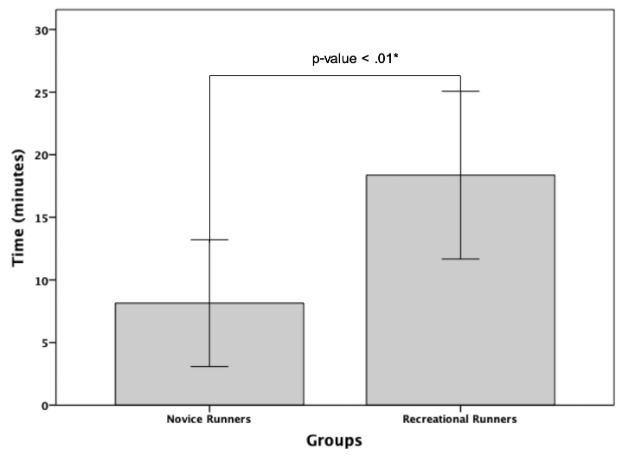
About Me
No biography provided yet