
Yana D. Belousova
Auto-generated profile, based on publicly available information
Yana D. Belousova
Immanuel Kant Baltic Federal University
Research Focus & Metrics
Explore full metrics on Scilit
Academic Career Length
4Years (2023-Present)
(Calculated once Scilit publication data is synced: current year − year of first publication + 1)
Representative Publications
View All Publications23 March 2023 in S.S. Korsakov Journal of Neurology and Psychiatry

Journal Article

Objective. To reveal clinical characteristics of asthenic syndrome with subsequent estimation of Meldonium therapy efficacy in patients in acute and early recovery periods of ischemic stroke. Material and methods. The study included 94 patients diagnosed with ischemic stroke, mean age being 65.6±9.5 years. Psychoemotional status was assessed on the 10th day of hospitalization with the use of the Asthenic Disorders Inventory (MFI-20), Hospital Anxiety and Depression Scale (HADS), Apathy Evaluation Scale (AES). Patients with verified asthenic syndrome were added Mildronate in a daily dose of 1000 mg (500 mg 2 times a day) for one month to baseline therapy in a real outpatient setting, followed by an assessment of treatment efficacy. Results. The presence of asthenic syndrome in patients in the acute period of ischemic stroke was detected on all subscales of MFI-20. A high level of general and physical asthenia was found in patients with subcortical localization stroke, with decreased motivation corresponding to lesions in the frontotemporal and decreased activity in the parieto-occipital lobes. Close correlations between the MFI-20 parameters and the level of depression, anxiety, apathy, and the degree of neurological deficit were found. The dynamic evaluation of the severity of main manifestations of psychoemotional dysfunction during treatment with Mildronate showed a decrease in the level of depression, general and mental asthenia, and decreased activity during the period of observation. Conclusion. The high prevalence and multifactorial character of asthenia in early ischemic stroke make it urgent to optimize the early treatment of asthenic syndrome. The results of assessment of Mildronate application in a daily dose of 1000mg for a month have shown therapy efficacy concerning affective and asthenic disorders, which allows recommending its inclusion in the complex therapy of ischemic stroke.
1 March 2023 in Kachestvennaya Klinicheskaya Praktika = Good Clinical Practice
Journal Article


YBY. D. Belousova
Y. D. BelousovaVRVladimir Vitaliy Rafalskiy
Vladimir Vitaliy RafalskiyEKE. D. Kislova
E. D. KislovaОсобенности мотивации добровольцев, участвующих в клиническом исследовании вакцины от COVID-19
19 April 2023 in Research Results in Pharmacology
Journal Article
LMLarisa V. Mikhailova
Larisa V. MikhailovaYBYana D. Belousova
Yana D. BelousovaEMEkaterina M. Moiseeva
Ekaterina M. MoiseevaATAlina A. Tsapkova
Alina A. TsapkovaNGNatalya D. Gazatova
Natalya D. GazatovaVRVladimir Vitaliy Rafalskiy
Vladimir Vitaliy Rafalskiy +3
Introduction: After the COVID-19 pandemic, public healthcare has faced a new problem, the persistence of symptoms, the most significant of which is undue fatigue. The definition of coronavirus infection as an endothelial disease suggests a possible relationship between asthenic syndrome and endothelial dysfunction. Aim: to evaluate endothelial function in patients after COVID-19 before and after treatment with combination drug of ethylmethylhydroxyperidine succinate (EMHPS)/vitamin B6. Materials and Methods: A prospective study included 33 participants, 82% women and 18% men aged 22 to 68 years after COVID-19. There were two site visits made in the course of the study and a 4-week treatment course between the visits. Results: After the treatment, the index of endothelium-dependent vasodilation increased in women and decreased in men. The differences were statistically insignificant. The number of subjects with a normal level of endothelium-dependent vasodilation increased from 7 to 11 after the treatment. The index of vascular wall stiffness corresponded to the mean age of the examined participants and did not statistically change, although women tended to decrease stiffness and men to increase it. The initial level of nitric oxide was lower in women and statistically significantly increased after treatment, while it remained unchanged in men. Discission: The study confirms a prolonged course of the post-covid. We assume that the virus destroys endothelial cells.Endothelial dysfunction is known to be associated with an increased cardiovascular risk. Conclusion: The indicators of endothelial function changed in patients after treatment with the drug. It is necessary to perform endothelial function studies in more patients after COVID-19. Graphical Abstract 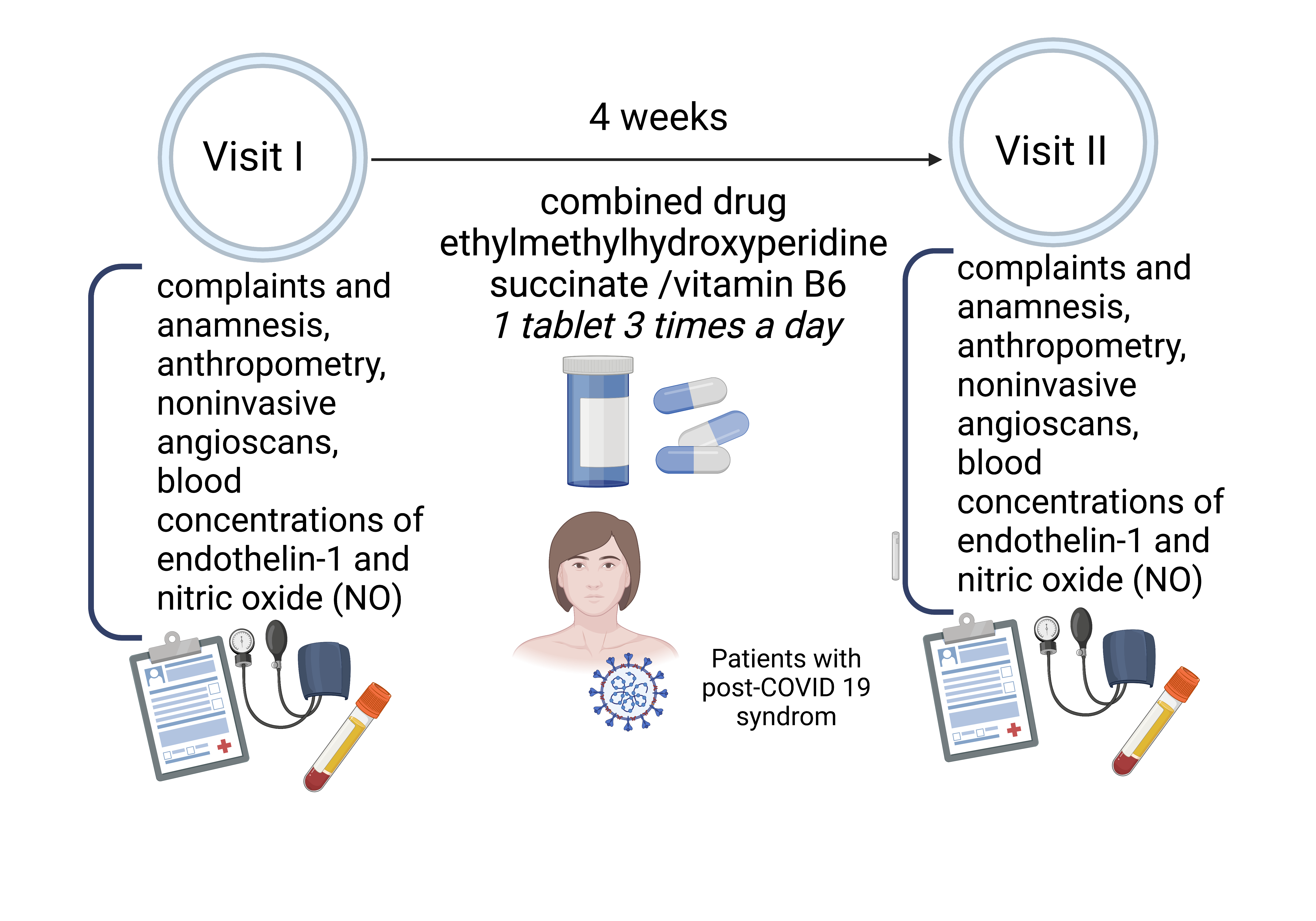
16 July 2025 in Research Results in Pharmacology
Journal Article
YBYana D. Belousova
Yana D. BelousovaNKNadezhda O. Kryukova
Nadezhda O. KryukovaIFIuliia A. Filimonkina
Iuliia A. FilimonkinaVRVladimir Vitaliy Rafalskiy
Vladimir Vitaliy RafalskiyIntroduction: Asthenic syndrome (AS) is increasingly prevalent, especially post-COVID, but its treatment lacks standardization due to unclear pathogenesis and diagnostic challenges. Current approaches rely on physician experience, underscoring the need for pharmacoepidemiological studies to optimize therapy. Materials and Methods: This study analyzed AS drug therapy (ICD-10 G90.8) in Kaliningrad region. A retrospective cross-sectional study of 358 patients (82 males, 276 females) evaluated outpatient and inpatient treatment using healthcare database records. Data were processed using Microsoft Access, Excel, and Statistica 13.3, with descriptive statistics (mean, median, mode, etc.). Results and Discussion: Showed 77% of AS patients were female, with monotherapy predominant (69.3% outpatients, 61.8% inpatients). Key drug subgroups included N07XX (48% outpatients, 66% inpatients – mainly succinic acid combinations) and N06BX (18% outpatients, 23% inpatients – primarily vinpocetine). Conclusion: Overall, 28 ATC drug subgroups were used, with greater variety in outpatient care. Common medications were ethylmethylhydroxyperidine succinate (EMHPS) and combinations of inosine, nicotinamide, and riboflavin. The findings highlight inconsistent prescribing patterns and the need for standardized protocols to reduce polypharmacy and improve outcomes.
7 May 2026 in FARMAKOEKONOMIKA. Modern Pharmacoeconomics and Pharmacoepidemiology
Journal Article
SSS. A. Stefanova
S. A. StefanovaYBYa. D. Belousova
Ya. D. BelousovaVRVladimir Vitaliy Rafalskiy
Vladimir Vitaliy Rafalskiy
Background
. Methotrexate (MTX) is a widely prescribed medication known for its pronounced anti-inflammatory and anti-tumor effects. However, its use is associated with risks of adverse drug reactions (ADRs) including gastrointestinal tract, infectious and haematological complications. This study analyzes spontaneous reports on ADRs to MTX in Russia, highlighting the importance of pharmacovigilance in ensuring the safety of pharmacotherapy.
Objective
: To examine the frequency and structure of ADRs that occurred following MTX administration through a retrospective analysis of spontaneous reports from the automated information system of the Federal Service for Surveillance in Healthcare (Roszdravnadzor) in Russia.
Material and methods
. A retrospective analysis of spontaneous reports registered from 2019 to 2024 in the Pharmacovigilance federal database (Roszdravnadzor) was conducted. To ensure accurate comparisons across regions, the incidence rates of the studied events were calculated per 100,000 population.
Results
. Between 2019 and 2024, a total of 2508 spontaneous reports concerning ADRs and/or MTX inefficacy were registered in Russia. The most frequent ADRs included gastrointestinal disorders (24.4%), combined reactions (21.9%), and drug inefficacy (15.1%). Male patients and those over 60 years of age had a statistically significantly higher risk of fatal outcomes. Allergic reactions resulted in “recovery without sequelae” in 51.7% of cases, while “condition improvement” was observed in gastrointestinal and neurological reactions (48.1% and 60.4%, respectively). Conversely, hematologic toxicity and infectious complications were associated with a higher risk of fatal outcomes (18.2% and 23.6%, respectively).
Conclusion
. Both national and international data confirm the need for meticulous monitoring and rational use of MTX to ensure therapeutic safety.
30 January 2024 in Research Results in Pharmacology
Journal Article
YBYana D. Belousova
Yana D. Belousova Anastasia Tynterova
VRVladimir Vitaliy Rafalskiy
Vladimir Vitaliy RafalskiyIntroduction: The problem of asthenic disorders is determined by their high prevalence, the lack of diagnostic criteria and recommendations for therapy, and the absence of unified principles of coding in ICD-10. The aim of the study was to evaluate the current practice of neurologists and physicians of the Russian Federation (RF) in the diagnosis and pharmacotherapy of asthenic syndrome (AS). Materials and Methods: An anonymous author-developed questionnaire survey of physicians on the issues of diagnostics and treatment of asthenia was conducted on the Google forms platform. Results: Total 238 specialists from 23 regions of the RF, 62.5% of neurologists and 37.5% of physicians, took part in the survey. Women suffer from AS more often than men. AS is most frequently verified at the age of 40-60 (65.5%) and under 40 (39.6%). Doctors use the codes G90.8 – other disorders of the autonomic nervous system – and I67.8 – other specified cerebral vascular lesions. The main causes of AS are affective disorders in 67.2% of patients and infectious diseases in 70% of patients. Almost 67% of doctors use anxiety and depression assessment scale, and only 13% of respondents use MFI-20 scale. The choice of therapy depended on the psychopathologic syndrome in 73.9% of cases. Most doctors favored nootropic drugs, metabolic action drugs, and B vitamins. Conclusion: The current medical practice of diagnosing and treating AS was studied and informative data were obtained with regard to understanding the clinical-typological structure and nosological affiliation of AS. The results demonstrate the expediency of developing a unified algorithm for the management of patients with various manifestations of AS.